
“100% Human Hair,” “Virgin Hair,” “Raw Hair,” “Remy Hair,” and “HD Lace” frequently appear together in catalogs and quotations. The real procurement risk isn’t how many labels a supplier uses, but rather what these labels actually mean for a specific order, what evidence supports them, and whether the main shipment and subsequent orders can consistently meet the same standards.
The conclusion: There is no single, simple action that can verify all material claims. Burning, feel, scratching, or a single wash can only provide limited clues; none can independently prove processing history, the number of donors, cuticle orientation, or batch consistency. A more reliable approach is to establish a verification chain of “Definition—Evidence—Sample—Mass Production—Reorder,” ensuring that each step aligns with the product’s intended use and acceptance responsibilities.
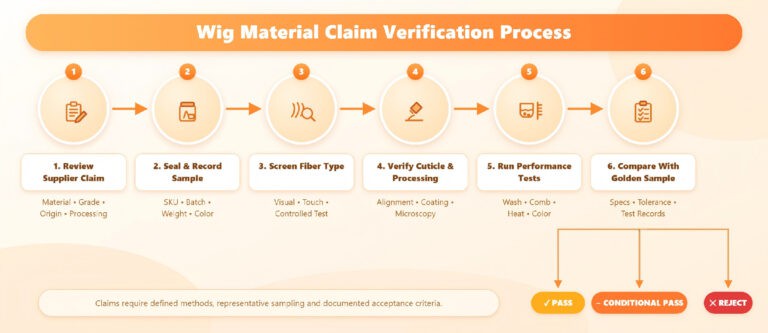
Have the supplier translate the label into the order specifications
Industry terminology does not inherently denote uniform quality grades. “Virgin Hair” typically implies a history of chemical processing, but different suppliers may have varying interpretations of how steam setting, texturizing, or surface treatments are classified as processing; “Remy Hair” usually refers to hair strands or cuticles oriented in the same direction, but does not automatically indicate the number of donors, whether the hair has been dyed, or batch consistency; and “HD Lace” cannot be assumed to imply a fixed thickness, mesh size, or edge finish based solely on the name.
Therefore, do not simply ask “Is it?” Instead, require suppliers to provide a written explanation of: how the label is defined for this SKU; which treatments are permitted and prohibited; whether it describes the hair strands, the base mesh, or the complete finished product; what the measurable specifications are; and what tolerances are allowed. Only by establishing these definitions first can subsequent testing and dispute resolution have a common benchmark.
The value of documentation lies in traceability, not merely “having a report”
Records of raw materials, processing, warehousing, and inspections can help track batches and narrow down the scope of investigation when issues arise. However, the documentation itself does not automatically prove that the current order is compliant. When reviewing reports or records, verify the product name, SKU, batch number, sample source, test date, test method, scope of testing, and issuing entity, and confirm the relationship between the tested sample and the bulk shipment to be delivered.
If the target market has additional requirements regarding safety, labeling, or chemical substances, you should also verify the applicable regulations based on product category and target region. A single generic document cannot automatically cover all markets, nor can it replace the verification of the current batch against the order specifications.
Sample Testing Aims to Determine “Fitness for Purpose”
The goal of sample testing is not to classify a product as “pass” or “fail,” but to determine whether it can fulfill the intended sales purpose. For human hair products, record color, texture, luster, hair ends, combing resistance, and hair shedding before and after washing under standardized conditions; for SKUs requiring heat styling, record the tools used, temperature, number of passes, and protective measures; for SKUs intended for bleaching or dyeing, use separate small strands to record the formula, processing time, lightening level, elasticity, and breakage.
For synthetic or blended fiber products, the composition, recommended temperature, curl retention, and changes after friction should be verified based on actual sales claims. For substrates such as lace, Mono, and PU, color, mesh size or thickness characteristics, elasticity, attachment structure, and actual performance upon installation should be recorded. An SKU that does not offer bleaching services does not need to undergo destructive bleaching for marketing purposes; testing must reflect real-world usage scenarios.
Visual demonstrations should only serve as a preliminary screening
Burning tests, hand feel, or scratching may help identify obvious anomalies, but they have significant limitations. Surface treatments can affect softness and luster; scratching may damage the sample; and burning behavior cannot trace the source or the complete manufacturing process. Microscopic observation and laboratory analysis can provide clues about material composition or surface morphology under appropriate methods and sample conditions, but they likewise cannot replace order specifications and batch traceability.
Purchasing decisions should be based on a combination of mutually supportive evidence: written specifications, traceable records, sample testing consistent with intended use, and verification of the confirmation sample against the production batch. No single demonstration should be promoted as a universal method of identification.
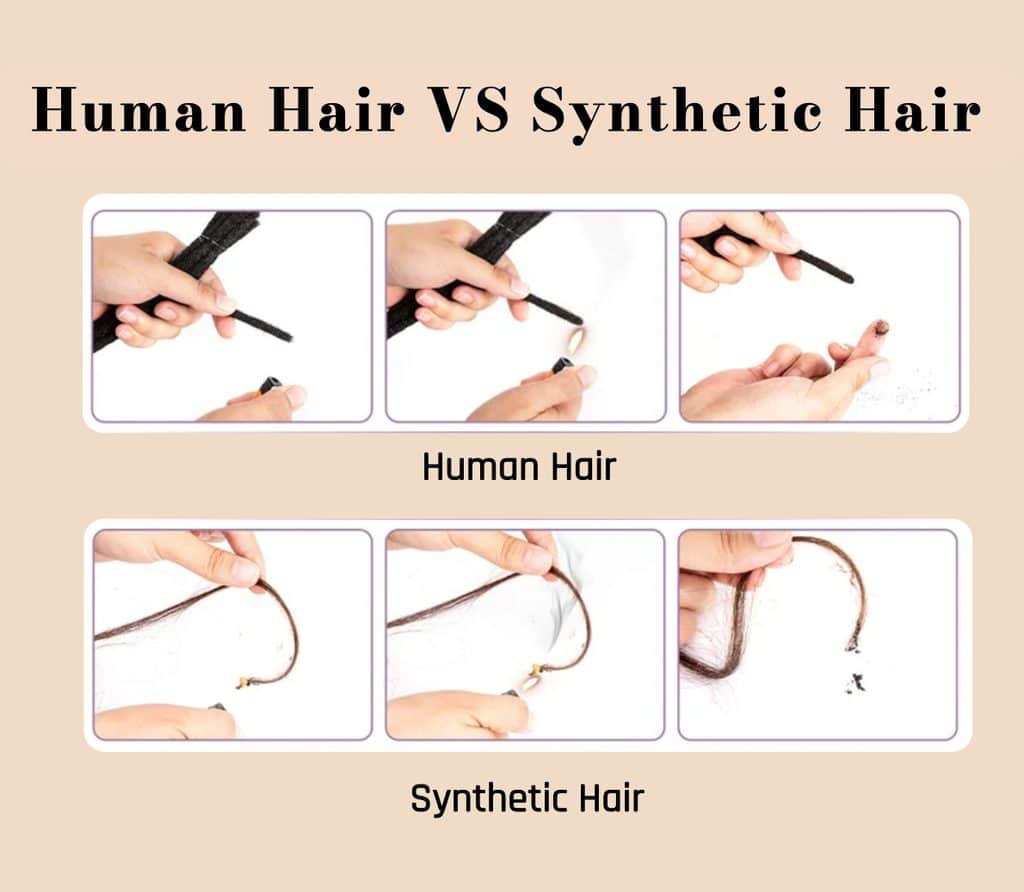
Translate the confirmation sample into enforceable production standards
Once a sample is approved, do not rely solely on chat records stating “quality is good.” Order specifications should cover material composition and processing declarations, color, texture, length, net weight, hair ends, cap size, base mesh, density, fastening methods, and packaging; they should also specify measurement methods, sampling procedures, allowable tolerances, and acceptance criteria. Reasonable variations may exist in natural materials, but such variations must fall within the range mutually agreed upon by both parties.
Seal the approved sample with batch and specification information, and retain untested retention samples and test records. Upon arrival of the production batch, take random samples by SKU and batch and compare them with the approved sample under the same conditions; do not inspect only the display pieces selected by the supplier. Reorders should also be verified using the same specifications and methods to determine whether the supplier can consistently reproduce the product.
Handling nonconformities is also part of the verification process
Before placing an order, the following must also be agreed upon: how nonconforming products will be isolated; under what circumstances rework, downgrading, or rejection is permitted; how the costs of restocking, refunds, and related shipping fees will be borne; and how corrective actions will be verified in the next batch. After-sales service and complaints must also be linked to the SKU, batch, and issue type to distinguish whether the problem stems from raw materials, production, transportation, installation, maintenance, or whether customer expectations were not properly managed.
Material labels should only serve as the starting point for procurement communication, not the conclusion of a quality assessment. Define the declaration; then confirm traceability evidence; verify intended use with samples; and finally, use approved samples and batch sampling to finalize the production run.