Two wigs may have similar purchase prices, yet the final profit margin can be completely different. The difference often doesn’t arise at the moment the order is placed, but rather after sample approval, bulk order processing, sales preparation, customer use, after-sales handling, and reorders.
Therefore, brand buyers should not merely compare “how much each unit costs,” but rather ask: How much did this SKU ultimately cost to deliver a finished product that meets the promise, is ready for sale, and can be used smoothly by the customer? This does not require calculating an absolutely precise figure during the prototyping stage, but rather establishing a set of cost metrics that can be continuously validated.
Place the cost comparison within the same product context
Whether a material is cost-effective depends on the product promise it supports. Products intended for professional salon installation, daily self-application, short-term photo shoots, or budget-sensitive markets have different requirements regarding natural appearance, stability, care, lifespan, and after-sales policies. If two SKUs differ in target price, usage methods, and service promises, directly comparing purchase prices or material unit costs is meaningless.
Before beginning the cost calculation, clearly define at least four things: who the target customers are; how the product is expected to be worn, maintained, and for how long; what care or after-sales services the brand promises; and how costs will be aggregated by market, SKU, batch, and observation period. This prevents mixing the costs of different product lines.
| Metric | Human Hair | Human Hair Blend | Heat-Friendly Synthetic | Standard Synthetic |
| Initial | CostHigh | Medium–High | Medium | Low |
| Expected Service Life | Long | Medium | Short–Medium | Short |
| Styling Flexibility | Excellent | Good | Moderate | Limited |
| Daily Maintenance | Higher | Medium | Medium | Low |
| Replacement Frequency | Low | Medium | Medium–High | High |
| Best Use Case | Premium daily wear | Mid-market programs | Fashion styles | Promotional/entry level |
Use each saleable finished unit, rather than a quote, as the unit of comparison
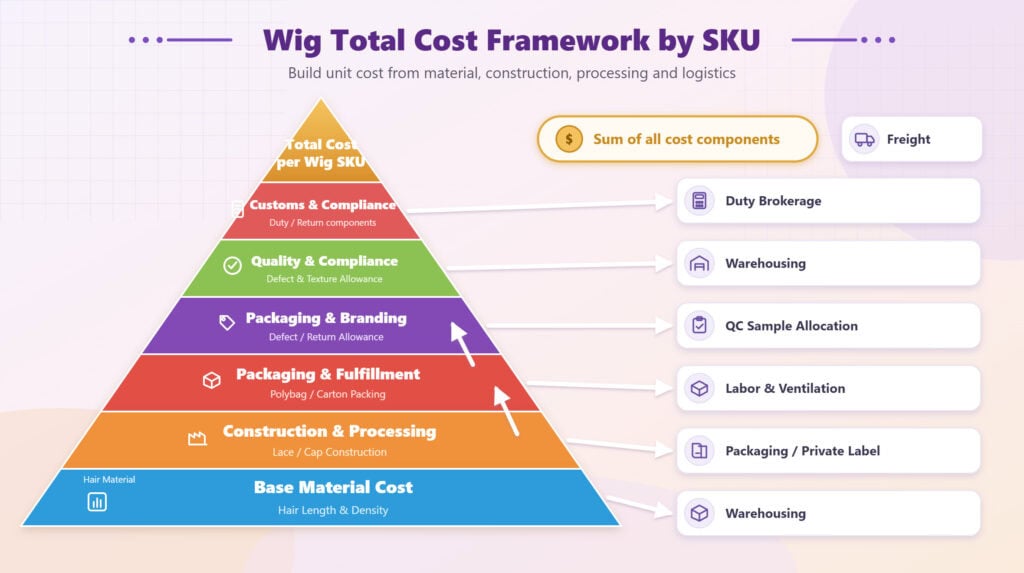
A practical long-term cost framework can be divided into four layers.
Cost-in-warehouse. This includes the product purchase price, samples, shipping, insurance, taxes, customs clearance, random inspections, and warehousing-related expenses. These are the easiest figures to obtain, but they do not represent the full cost.
Sales Preparation Costs. Record the cleaning, styling, trimming, hairline treatment, packaging, rework, and labor hours required per unit to meet shelf-ready standards. If a batch of products requires significant remedial work after arrival at the warehouse, a low purchase price does not necessarily result in lower overall costs.
Incurred After-Sales Costs. These include customer service handling time, repairs, replacement shipments, exchanges, refunds, markdowns, and issue investigations. Each expense must be traced back to the SKU, batch, and issue type—such as tangling, hair shedding, edge damage, size mismatches, or improper installation. Without this categorization, it is impossible to distinguish between isolated incidents and recurring failures.
Business Impacts Pending Verification. Inventory tie-up, markdown periods, reduced repeat purchases, or damage to word-of-mouth referrals may be significant, but they typically cannot be precisely attributed to a single complaint. These should be recorded separately as hypotheses or trends and must not be combined with actual expenses to form a definitive figure.
Material Labels Cannot Substitute for Cost Conclusions
Human hair, synthetic hair, and blended hair may all be suitable for specific products, but they may also increase costs when used in the wrong context. Whether human hair delivers on its styling potential and aesthetic performance depends on the condition of the raw material, processing history, color, density, base cap, and the customer’s ability to care for it; similarly, the pre-set texture, heat resistance range, friction performance, and resilience of synthetic or blended hair must be evaluated in conjunction with specific specifications.
Similarly, thinner lace or more complex cap structures do not automatically increase profits. While they may help achieve a certain hairline or wearing experience, they may also increase the demands for installation, removal, cleaning, and after-sales guidance.If the target customer does not require deep bleaching, complex styling, or an extremely low-visibility edge, there is no reason to pay extra for features that cannot be utilized; conversely, if the product promises these experiences but lacks the appropriate materials, instructions, and services, after-sales costs may escalate following the sale.
Let Sample Testing Answer Cost Questions
Testing is not intended to prove that a product can withstand every possible use, but rather to verify that it is suitable for the intended purpose.For everyday wear SKUs, record tangling, hair loss, texture, hold, and changes to the base mesh under established washing, combing, drying, and repeated donning/doffing conditions; for SKUs requiring heat styling, record the tools used, temperature, frequency, and protective measures; for SKUs intended for bleaching, use separate small samples to record the formula, lightening effect, elasticity, and breakage. Do not conduct destructive testing for marketing purposes on features not intended to be offered.
Test records must include the sample batch number, descriptions of materials and construction, operating conditions, results, and acceptable limits. After a sample is approved, a reference sample must be sealed for archival purposes; during random inspections of production runs, verification must follow the same method; and for backorders, the same specifications and record forms must continue to be used. This enables the team to determine whether a cost variance stems from material differences, process changes, or a mismatch between sales promises and actual usage conditions.
Review Material Selection Using After-Sales and Inventory Data
Each month or sales cycle, aggregate costs by SKU, supplier, batch, and issue type. If rework time, return/exchange rates, or discount cycles for a particular SKU remain consistently high, revisit the confirmation samples, specifications, installation instructions, and target customer scenarios to investigate; if a higher-cost configuration consistently reduces rework, after-sales issues, and inventory losses, verify whether this difference recurs across multiple batches before deciding whether to expand procurement.
Truly professional procurement does not mean always choosing the most expensive materials, nor does it mean merely negotiating the lowest initial quote. It involves, based on a clear product positioning, using traceable records to determine which combination of materials and structures can deliver on the promise to customers at a reasonable cost. Validate with a small data set first, then decide whether to scale up procurement.
While payment is made at the time of ordering, costs related to rework, maintenance, inventory, and customer service continue to accrue after the sale. Can you trace every major post-sale cost back to a specific SKU, batch, and issue type?