
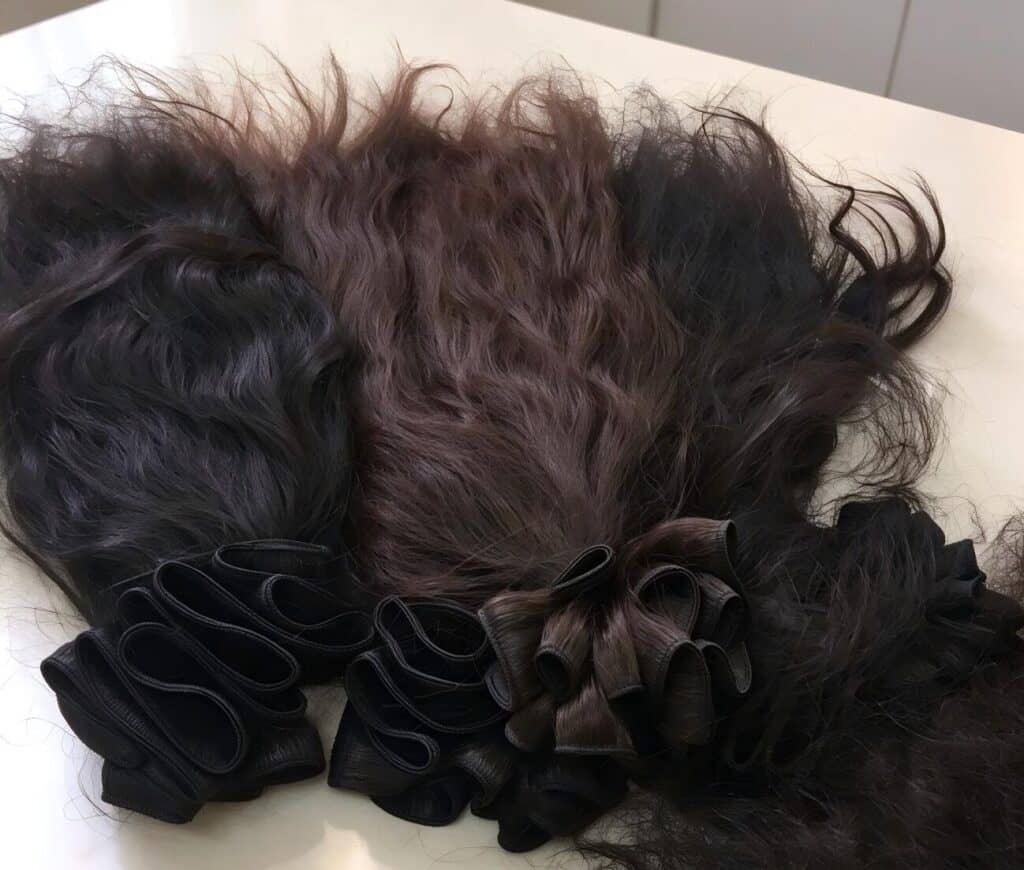
When purchasing human hair, the most common source of misjudgment isn’t the sheer number of hair terms, but rather the tendency to rank these three distinct categories into a fixed hierarchy.
A single batch of hair can be described as both “Virgin Hair” and “Remy Hair”; being labeled “Raw Hair” does not automatically mean it’s suitable for repeated lightening or that it will remain completely consistent with every subsequent order.
For brand procurement and product development, a more useful assessment involves determining what processing the raw material has undergone, how the hair strands are oriented, and whether it can withstand your actual product testing.
Let’s break down the three terms first
“Raw Hair” is often used to describe human hair that retains much of its natural state and has not undergone significant chemical alterations. However, not all suppliers use the same criteria for this quality grade. Before purchasing, request a written clarification from the supplier regarding whether the hair has been dyed, bleached, textured, or steam-set; whether it has undergone surface treatments; and the specific definition of “Raw” in their specifications.
“Virgin Hair” typically emphasizes that the hair has not undergone chemical treatments such as dyeing, bleaching, or perming; however, opinions may vary among suppliers regarding whether washing, texturizing, steam setting, and surface treatments are considered “processing.” Therefore, “Virgin” should be treated as a raw material and processing claim to be verified, rather than a conclusive purchasing criterion.
“Remy Hair” typically emphasizes that the hair strands are kept as aligned as possible during collection, sorting, and processing, resulting in more consistent cuticle orientation and thereby reducing the risk of tangling caused by reverse friction. It does not automatically prove that the hair comes from a single donor, is uncolored, has not undergone texturizing, or that batches are necessarily consistent.
Don’t ask which grade is higher—first ask what the product will be subjected to
Selection should be based on the end product:
- For high-end lines featuring natural colors and accepting reasonable textural variations: Focus on confirming the condition of the raw material, the integrity of the hair ends, and the range of natural variations.
- For products requiring lightening, dyeing, or repeated styling: Use uniform small bundles for testing to verify lightening performance, elasticity, and breakage, rather than relying solely on labels.
- For everyday wear where low-maintenance is a priority: Compare tangling, frizz, hair shedding, and the condition of the ends in both wet (after washing) and dry hair.
- For ongoing restocking needs: Prioritize discussing batch consistency, sample confirmation, and spot-checking protocols before addressing “Raw Virgin Remy.”
Turn Terminology Statements into Acceptable Sample Requirements
A single instance of burning, scratching, or washing cannot independently verify the processing history. A more reliable approach is to have the supplier provide written specifications first, then compare samples under identical conditions:
- Clearly document the specifications. Record the raw material description, permitted and prohibited treatments, texture source, length, net weight, color range, and acceptable natural variations.
- Standardize testing. Under the same washing, combing, and small-bundle dyeing conditions, document color variation, texture recovery, tangling, shedding, elasticity, and breakage; these results are used to determine suitability for your application, not to independently verify the authenticity of the label.
- Archive confirmation samples. Retain reference samples labeled with batch and specification information, and document the test formula, date, and results.
- Define Acceptance Criteria for Production Batches. Before placing an order, agree on sampling methods, allowable tolerances, procedures for handling anomalies, and methods for verifying replacement orders, ensuring that both the first batch and subsequent batches adhere to the same standards.
“Raw,” “Virgin,” and “Remy” are the starting points for communication, not the end of a quality commitment. What truly reduces post-sale risks is a shared, actionable understanding between both parties regarding the processing history, intended use, testing methods, and batch acceptance criteria.
| Raw Hair | Virgin Hair | Remy Hair |
| Single-donor emphasis | No chemical processing | Cuticles aligned |
| Natural texture variation | May be steam-textured | May be processed |
| Highest customization potential | Consistent commercial textures | Smooth, manageable performance |
| Premium price tier | Mid-to-premium tier | Broad price range |
When sourcing human hair, what is the most difficult aspect to verify: processing history, bleaching and dyeing performance, or consistency in replenishment orders? If you are establishing sample acceptance criteria, we recommend starting with a reference specification sheet and a record of confirmed samples.